Why SS Mart Exists: Bringing Indonesia's Sambal Culture to Australian Tables
michael samsir
Lead author at Rolly.
SS Mart exists because authentic Indonesian sambal — the real thing, made properly — was missing from Australian tables. Discover the story behind Australia's freshest Indonesian condiment kitchen, why sambal is so much more than hot sauce, and how we're bringing one of Indonesia's most beloved culinary traditions to every postcode across the country.
There is a particular kind of hunger that has nothing to do with an empty stomach.
Ask anyone who has lived far from home for any stretch of time. It is the hunger for a specific smell — the heat of toasted chillies hitting a stone mortar, the sweet-savory lift of kecap manis, the sharpness of shallots softening in oil. It is the hunger for food that tastes like the people who made it. For Indonesians living in Australia, that hunger often went unanswered. Until now.
Sambal Is Not Hot Sauce
Let us be clear about something before we go any further: sambal is not a condiment in the way that tomato sauce or mustard is a condiment. It is not something you squeeze onto food because it needed a little lift. Sambal is a category — a broad, deeply considered family of chilli-based pastes and sauces that sit at the very heart of Indonesian cooking.
There are hundreds of regional sambals across the Indonesian archipelago. Some are cooked low and slow until the oil rises and the flavours deepen. Others are fresh, raw, pounded just minutes before eating. Some are built on fermented shrimp paste for an umami so profound it changes a dish entirely. Others use kaffir lime leaves, lemongrass, or candlenut to create flavour profiles that have no equivalent in any other cuisine on earth.
A sambal is not an afterthought. In Indonesian households and restaurants alike, it is the thing that makes a meal complete. Rice and sambal is not a bare option — it is a statement of sufficiency. Noodles, grilled fish, fried chicken, tofu, tempeh: the sambal is what unifies them, what gives the table its character, what people reach for first and last.
To bring sambal to Australia is to bring not just a flavour, but an entire approach to eating.
What Indonesian-Australians Had to Do Without SS Mart
Before SS Mart, the options for Indonesian-Australians seeking genuine, freshly made sambal were limited and unsatisfying.
You could attempt to import jars from overseas — shelf-stable products that had been pasteurised, preserved, and shipped across thousands of kilometres, arriving with a flavour that bore only a polite resemblance to the original. You could drive to specialty grocery stores and hope that this week's stock had not run out, or that the batch had not been sitting too long. You could make it yourself from scratch, sourcing dried chillies and shrimp paste from across the city, spending hours at a mortar and pestle to produce something that tasted right but consumed the better part of a Sunday.
Or you could simply go without.
For many, going without was the quiet default. The meal was fine. The flavours were acceptable. But something was missing — that particular dimension of heat, depth, and aroma that sambal provides and that nothing else replicates.
This gap in the market was not the result of Australian indifference to Indonesian food. It was a supply problem. Nobody had built a local kitchen dedicated to producing fresh, authentic Indonesian sambals at scale and making them available to anyone with an Australian postcode.
The Waroeng SS Connection
SS Mart's roots run deep — back to Yogyakarta, Indonesia, and a restaurant that became a legend.
Waroeng SS Spesial Sambal began in the shadow of Universitas Gadjah Mada, one of Indonesia's most prestigious universities. It grew from a humble warung — the Indonesian term for a small, family-run eating establishment — into one of the country's most recognisable sambal-focused restaurant chains. Its reputation was built on a single, uncompromising premise: sambal done properly, served to everyone.
That heritage is not merely decorative for SS Mart. It is structural. Every jar we make in our Carlton kitchen carries the philosophy that made Waroeng SS a household name in Java: that sambal should be made with care, from good ingredients, and that the quality should never be negotiated away for the sake of convenience or cost-cutting. You can read more about the full origin story.
What we have built in Melbourne is not a pale imitation of something Indonesian. It is an extension of something genuine — a continuation of a tradition that has been feeding people well for decades.
The SS Mart Mission: Fresh, Local, Available to Everyone
Our mission is simple to state and harder to execute: make freshly made Indonesian sambals available to everyone in Australia.
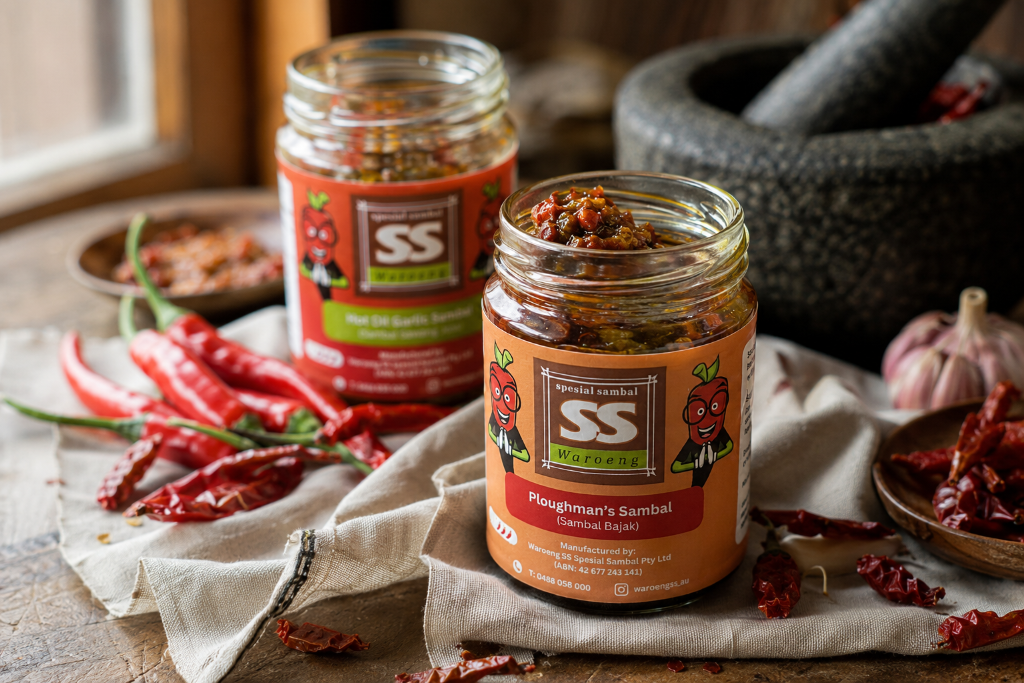
Not mass-produced imports. Not shelf-stable compromises. Not something that spent six months in a shipping container before arriving at a warehouse. We make our sambals in our Carlton, Victoria kitchen from quality ingredients, in batches sized for freshness, and we ship them across Australia so that anyone with an address can order them.
The Carlton kitchen is not incidental to what we do — it is the whole point. Making sambal in Australia means we control the process. We know when the batch was made. We can maintain consistency without sacrificing the qualities that make each variety distinct. We can respond to demand. And we can ensure that what reaches you is as close as possible to what you would find in a good Indonesian kitchen.
Fresh matters in sambal. The aromatic compounds in chillies, shallots, and lemongrass degrade over time. The interplay of ingredients — the way a cooked sambal deepens after a proper resting period, the way raw ingredients retain their brightness — is a function of time and care, not of manufacturing shortcuts. We take the time. We apply the care.
The Vision: All of Australia
We are based in Melbourne. But we do not think of ourselves as a Melbourne business.
E-commerce means geography should not determine access to quality food. If you live in Perth, Cairns, Hobart, or anywhere in between, you should be able to order a jar of genuinely made Indonesian sambal and have it arrive at your door. That is the vision we are working towards: a country where the barriers to accessing authentic Indonesian flavours are simply, permanently removed.
This matters beyond convenience. Food is how cultures stay connected. It is how the children and grandchildren of Indonesians who settled in Australia remain linked to something real about where their families came from. It is how non-Indonesian Australians encounter one of the world's great culinary traditions on its own terms, not as a diluted approximation.
We want SS Mart jars in Australian kitchens everywhere — not as a novelty, but as a staple.
Who SS Mart Is For
The short answer: anyone who cooks and cares about flavour.
That includes Indonesian-Australians who have been waiting for a product that tastes like the sambals they grew up with. It includes households with Indonesian heritage — people whose parents or grandparents brought these flavours to Australia, who want to continue that tradition without spending hours at a mortar and pestle every time.
It includes multicultural households who have been introduced to Indonesian food through friends, travel, or restaurants and want to cook with these flavours at home. It includes food explorers — the curious cooks who are already comfortable with harissa, gochujang, and berbere, and are ready to discover what Indonesian chilli pastes bring to their repertoire.
And it includes people who have simply not encountered Indonesian sambal yet, but whose palates are waiting for it.
Sambal rewards the adventurous cook. It is versatile, complex, and deeply satisfying. A good jar of sambal changes what is possible in a home kitchen. It becomes the thing you reach for without thinking — the flavour foundation for a quick stir-fry, the finishing heat on grilled chicken, the depth beneath a simple bowl of fried rice.
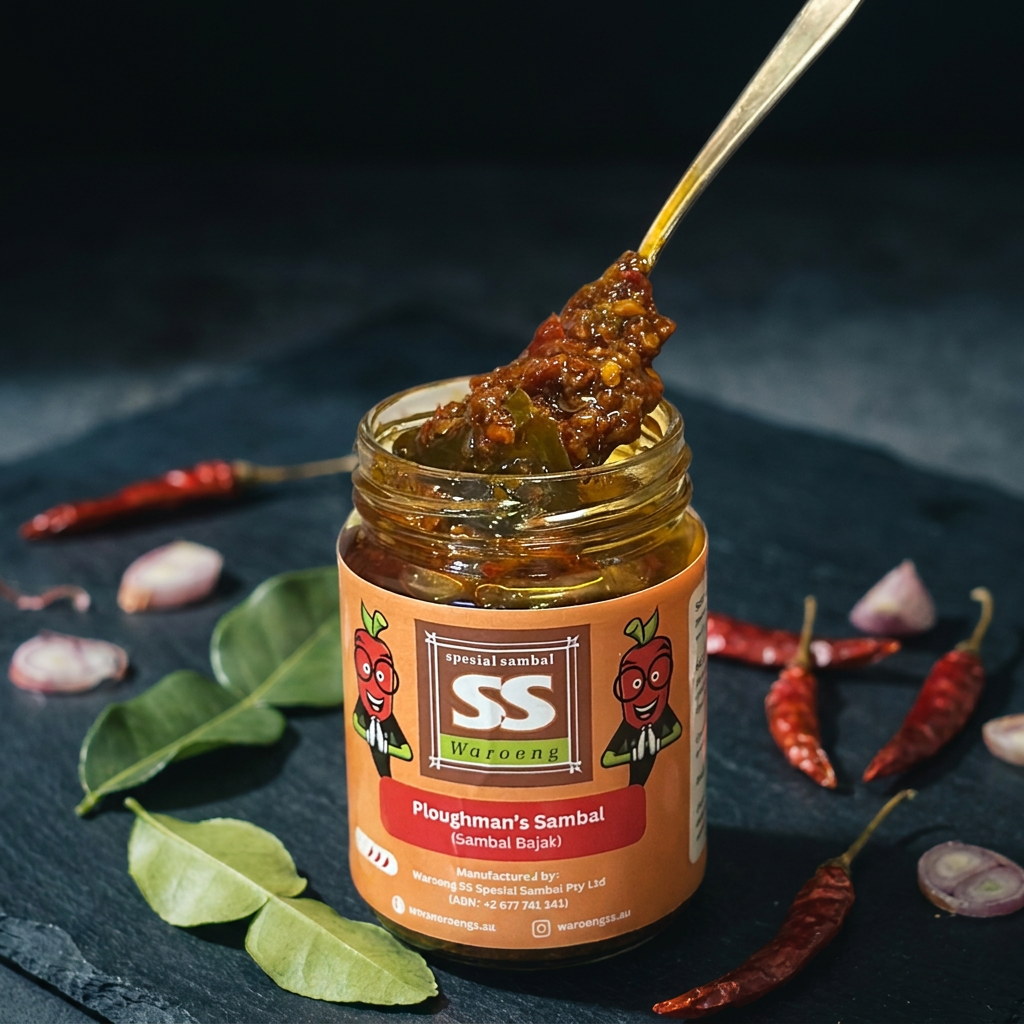
Browse our full range of sambal jars — made fresh in our Carlton kitchen and shipped across Australia. Shop the SS Mart range here.
Image caption: Jars of freshly made SS Mart sambal, prepared in our Carlton kitchen.
Recipe: Nasi Goreng Kampung (Village Fried Rice)
Nasi goreng kampung — village fried rice — is the version most Indonesians grew up eating. It is more pungent than the restaurant version, built on simpler ingredients, and absolutely dependent on a good sambal for its character. Day-old rice is essential: freshly cooked rice holds too much moisture and turns the pan into a steaming exercise rather than a frying one.
This recipe serves 2.
Ingredients
- 2 cups day-old cooked white rice (jasmine or medium grain)
- 2 eggs
- 3 cloves garlic, finely minced
- 2–3 shallots, thinly sliced
- 1 tablespoon kecap manis (Indonesian sweet soy sauce)
- 1–2 tablespoons SS Mart sambal of your choice (Bajak, or Bawang Joss work particularly well)
- 1 tablespoon neutral cooking oil
- Salt to taste
- To serve: sliced cucumber, fried shallots, and a fried egg if desired
Method
- Prepare the base. Heat the oil in a wok or large frying pan over high heat until shimmering. Add the sliced shallots and cook, stirring frequently, for 1–2 minutes until softened and beginning to colour at the edges. Add the minced garlic and cook for a further 30 seconds until fragrant.
- Add the sambal. Add 1–2 tablespoons of SS Mart sambal to the wok and stir it through the shallot and garlic mixture. Cook for 1 minute, allowing the sambal to fry in the oil and deepen in flavour. This step is what gives nasi goreng kampung its characteristic depth — do not rush it.
- Add the rice. Add the day-old rice to the wok, breaking up any clumps with a spatula. Toss everything together until the rice is evenly coated with the sambal mixture. Spread the rice across the surface of the wok and allow it to sit undisturbed for 30–40 seconds so that the base develops a slight crust and char. Toss again and repeat once more.
- Season and finish. Add the kecap manis and toss well to coat. Push the rice to one side of the wok, crack the two eggs into the cleared space, and scramble them briefly before folding them through the rice. Season with salt if needed — the kecap manis and sambal are both seasoned, so taste before adding more.
- Serve. Divide between two plates. Serve immediately with sliced cucumber on the side and a scattering of fried shallots on top. A fried egg on top of each portion, cooked until the edges are crisp and the yolk remains runny, is the traditional finishing touch.
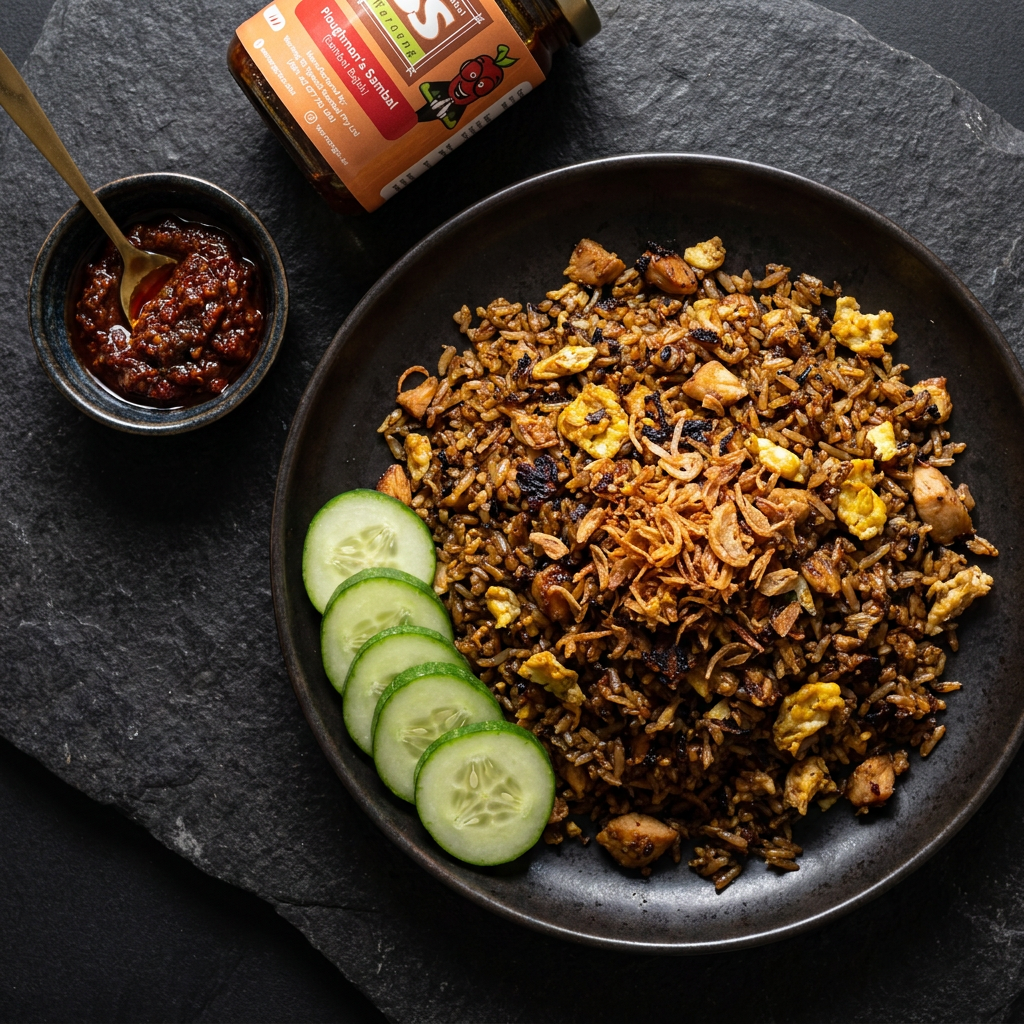
Image caption: Sambal has been at the heart of Indonesian cooking for centuries — now it's available across Australia.
Bagikan